
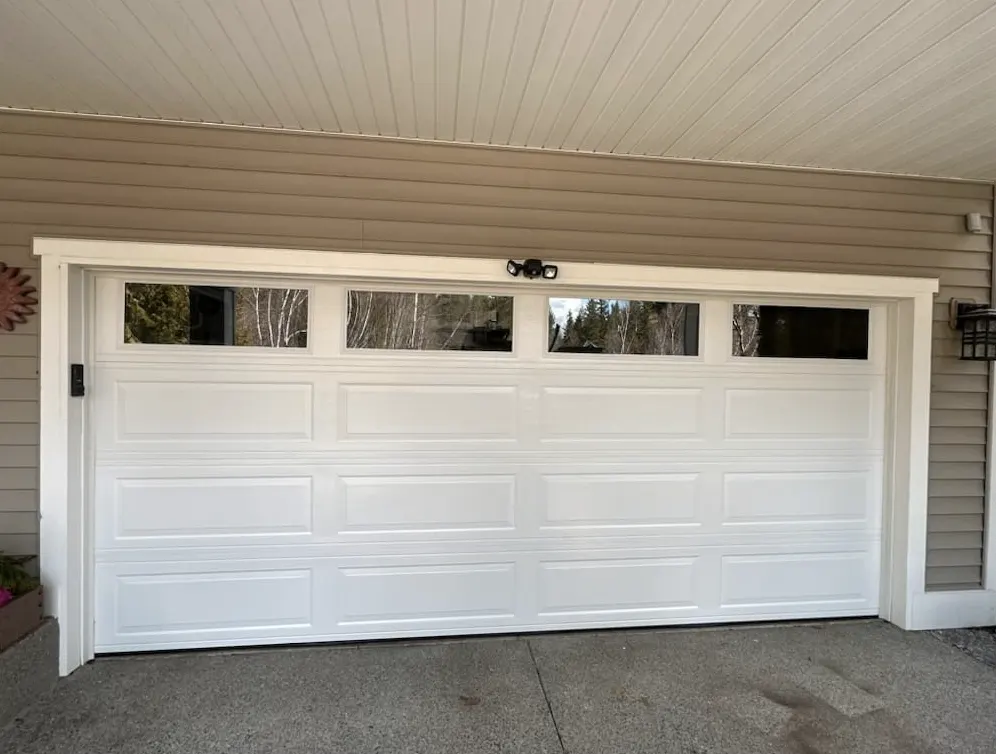
What the technician sees on this call
It's usually two people standing in the driveway. One wants the insulated door because "it'll help with the heating bill." The other thinks it's a waste of money on a door that's open half the day anyway. The garage behind them tells the real story: an attached garage with a bedroom over it, a single-layer steel door from the original build, and a gap under the weatherstripping you could slide a pencil through. The R-value conversation usually isn't the argument that needs settling. The air leaks are.
What R-value on a garage door actually measures
R-value measures resistance to heat transfer through the door panel itself, tested in a lab under controlled conditions. It does not measure how much heat escapes around the edges, through the bottom seal, or through the gaps where panel sections meet. On a garage door, those gaps matter more than they do on a wall, because a garage door has more moving joints and a bigger bottom seal than almost any other opening in the house. A door rated R-16 with a worn-out bottom astragal and loose weatherstripping can perform worse than a lower-rated door that's properly sealed.
Manufacturers also calculate R-value per layer of material, not always for the assembled door as installed. Two doors advertised at similar R-values can perform differently depending on whether they use polystyrene panels (cheaper, lower performance) or injected polyurethane foam (better insulating value, better structural rigidity, usually a higher price).
Who genuinely benefits from an insulated door
- Attached garages with living space above or alongside them. If there's a bedroom, playroom, or laundry room sharing a wall or ceiling with the garage, an uninsulated door is a direct path for cold air in winter and heat in summer.
- Garages that are heated or used as workshops. If anyone actually works out there in January, insulation and good seals together keep the space usable without burning through propane or electric heat.
- Homes with original doors from the '80s and '90s. A lot of the older housing stock in this area still has single-layer steel doors with no thermal break. Swapping to an insulated door is a real upgrade, not just a number on a brochure.
- Anyone bothered by noise. Insulated doors with foam cores are noticeably quieter, which matters if the garage sits under a bedroom or near a home office.
- Anyone dealing with condensation. Humid summers followed by cooler nights cause condensation to form on cold, uninsulated steel. An insulated door's interior surface stays closer to room temperature, which cuts down on that sweating and the rust it eventually causes.
Who is paying for a number they'll never use
- Detached, unheated garages used only for parking and storage. There's no adjacent living space to protect and no reason to maintain a temperature inside. The R-value has nothing to do.
- Garages with an already well-sealed envelope. If the walls, man-door, and attic access around the garage are insulated and sealed but the garage door itself gets swapped for a high R-value model while everything else leaks, the upgrade is diluted to the point of being pointless.
- Anyone chasing the highest R-value number for its own sake. Beyond a certain point, the return flattens out fast. A mid-range insulated door with a tight seal will outperform a premium high-R door with sloppy weatherstripping, every time.
The seal matters as much as the panel
Before spending more on a higher R-value door, it's worth checking three things that cost far less to fix: the bottom seal (should be pliable, not cracked or flattened), the weatherstripping along the sides and top (should sit flush with no daylight visible), and the threshold where the door meets the driveway (gaps here let in both cold air and meltwater during freeze-thaw cycles). A new insulated door installed over a bad threshold seal is still going to leak air and let in slush in February.
The honest trade-off
Insulated doors cost more upfront, generally landing in a higher price range than standard steel doors, and that gap grows with polyurethane-core models versus polystyrene. For an attached garage with living space nearby, that cost difference pays back in comfort and lower strain on the HVAC system touching that wall. For a detached garage used for lawn equipment and a lawnmower, it's money better spent elsewhere, like a new opener or spring replacement that actually affects how the door performs every day.
When to call Highland Park Garage Door
If the argument in the driveway comes down to whether an insulated door is worth it for your specific garage, that's a five-minute conversation once someone looks at how your garage connects to the rest of the house. We handle garage door installation with both polystyrene and polyurethane insulated options, and we'll tell you honestly if your money is better spent on sealing up what you've got through garage door maintenance instead. Either way, you get a straight answer, not an upsell.
Call Highland Park Garage Door to get a real assessment for your home in Highland Park, NJ, or anywhere nearby in Middlesex County.